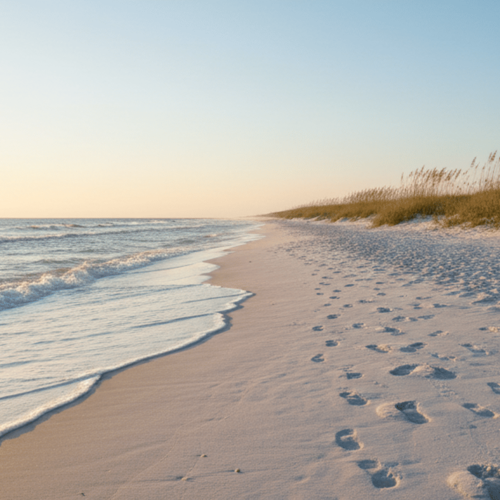

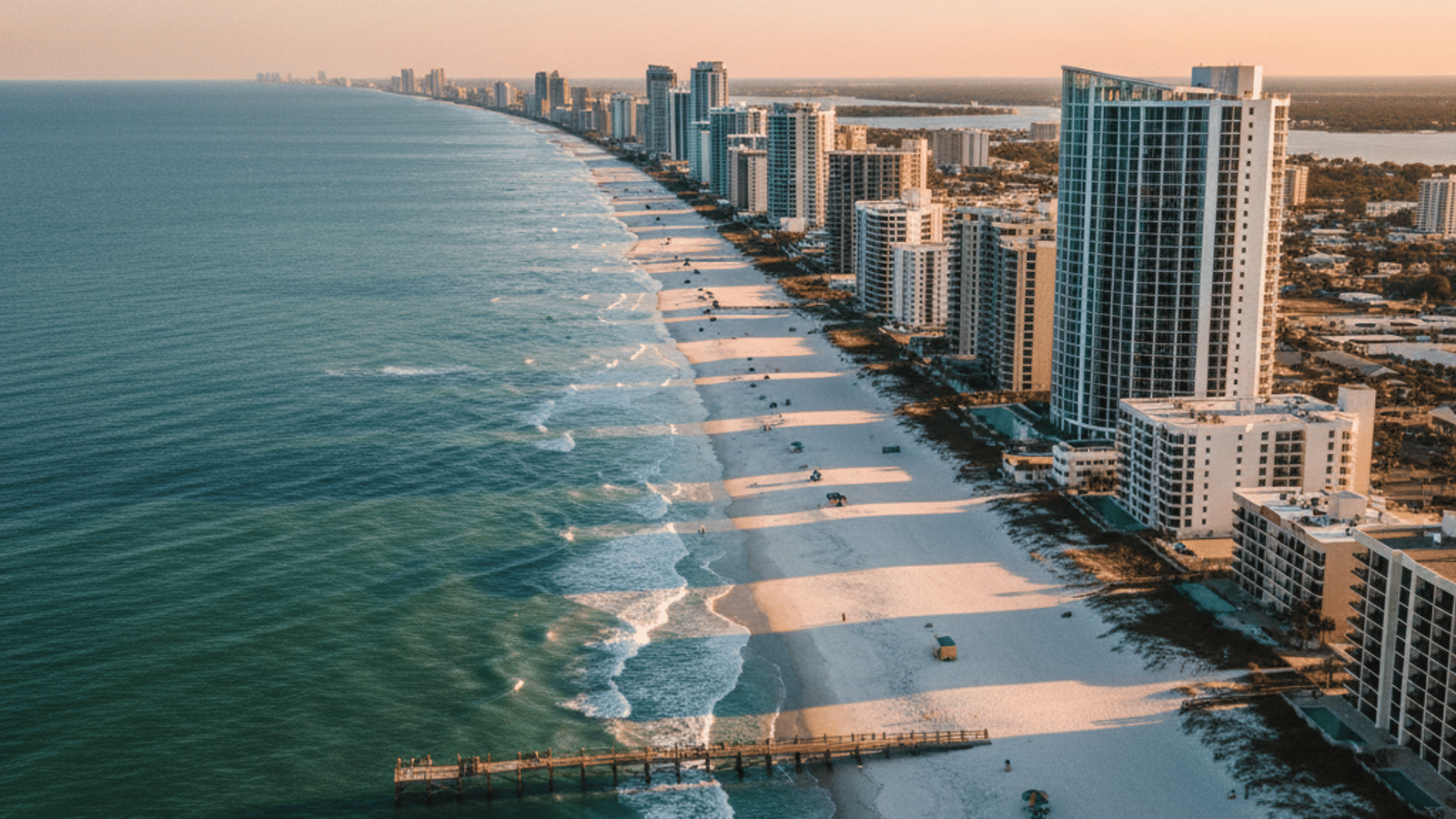
If you stand on a balcony overlooking the emerald water today, seeing the wall of high-rises and the bustling activity of Front Beach Road, it is almost impossible to imagine that not so long ago, this area was nothing but sand dunes and scrub oak. As a local, I talk to people every day who are thinking about living in Panama City Beach, and I always tell them: to understand where this market is going, you have to understand where it came from.
The story of "PCB" isn't just about tourism. It is a story of infrastructure, resilience, and a few ambitious visionaries who looked at a remote stretch of barrier island and saw potential. It is also important to clear up the most common confusion for newcomers right off the bat: Panama City and Panama City Beach are two entirely separate cities. Panama City is the historic port town on the mainland; Panama City Beach is the resort municipality on the coast. The "World’s Most Beautiful Beaches" tagline wasn't just marketing—it was the foundation for a real estate evolution that turned a quiet fishing village into the powerhouse skyline we see in 2026.
Before the Bridges: The Early Settlement Era (Pre-1930s)
Before the developers arrived, this region was a rugged, difficult-to-reach barrier island separated from the mainland by St. Andrews Bay. In the early 20th century, if you wanted to get to the beach, you needed a boat. The economy back then wasn't based on condos or sunscreen; it was driven by fishing, homesteading, and the military presence at nearby coastal defense posts, which would eventually evolve into Tyndall Air Force Base.
Real estate values during this time were nonexistent by modern standards. The land was beautiful, sure, but without easy access, it was virtually worthless for commercial development. The pivotal moment that changed everything was the opening of the first Hathaway Bridge (originally the St. Andrews Bay Bridge) in 1929. This engineering feat finally connected the mainland population to the beach, turning an isolated strip of sand into a destination that could actually be reached by car.
Gideon Thomas and the Birth of a Resort City (1930s-1940s)
While the bridge provided the access, it took a visionary to provide the reason to visit. That visionary was Gideon Thomas. In 1933, right in the middle of the Great Depression when most people were holding onto every penny, Thomas purchased 108 acres of beachfront property. People thought he was taking a massive gamble, but he had a plan.
By 1936, Thomas held the "Grand Opening" of what we now know as Panama City Beach. He developed the first hotel, built cottages, and constructed the original 1,000-foot pier to attract fishermen and sightseers. He famously told skeptics, "I’m going to raise people, not corn."
Following his lead, the Long Beach Resort area began to sprout up. It wasn't the high-rise luxury we see today; it was a "strip" of small motels, wooden cottages, and roadside stands. This era established the friendly, approachable vibe that still lingers in parts of the community today, proving that the area could support a dedicated tourist economy.
The 'Miracle Strip' Era and Family Tourism (1950s-1980s)
Post-World War II, the area really hit its stride as a classic American roadside destination. The stretch of US Highway 98 that runs along the coast earned the nickname the Miracle Strip, becoming a neon-lit beacon for families driving down from the deep South.
The centerpiece of this era was the Miracle Strip Amusement Park, which opened in 1963. For decades, the Starliner rollercoaster was practically the unofficial monument of the city. During this time, the social scene revolved around places like The Hang Out, founded in the 1950s, which became the epicenter of teenage life and early rock-n-roll culture in the area. This was a popular destination for families in Panama City Beach.
From a municipal standpoint, things got serious in 1970, when West Panama City Beach, Panama City Beach, Edgewater, and Long Beach all merged to incorporate into the single municipality of Panama City Beach. The housing stock defined this era: single-story concrete block motels, A-frame cottages, and the very first low-rise condos began to appear. It was affordable, accessible, and booming.
From 'Redneck Riviera' to Spring Break Capital (1990s-2015)
As the 20th century wound down, the city's identity shifted again. In 1978, the New York Times famously used the term Redneck Riviera to describe the region. While outsiders might have meant it as a slight, for many locals and visitors from Alabama, Georgia, and Tennessee, it became a badge of honor—a symbol of an unpretentious, working-class paradise.
However, the 1990s brought a massive cultural shift: the MTV Spring Break era. For roughly two decades, March became a chaotic boom time, with hundreds of thousands of college students descending on the city. It created an explosion in the short-term rental market, but it also put a massive strain on the community's infrastructure and reputation.
The real estate market began to feel the tension between being a party town and a residential community. The pivot point came in 2015, when local government passed strict laws banning alcohol on the sandy beach during the month of March. This decision effectively ended the chaotic Spring Break era and signaled to investors that PCB was rebranding itself back toward luxury and sustainable tourism.
The Modern Renaissance: St. Joe, Pier Park, and the Condo Boom (2000s-Present)
If you are looking at condos for sale in Panama City Beach today, you are looking at the results of the massive transformation that began in the early 2000s. The biggest driver of this change was The St. Joe Company. Once a paper and timber giant, they transitioned into Florida's largest private landowner and developer, shifting their focus from growing trees to building communities.
Two major infrastructure projects redefined the map during this period:
- Pier Park (Opened 2008): This replaced the old souvenir shops with a regional lifestyle center, giving the beach a true "downtown" for shopping and dining.
- Northwest Florida Beaches International Airport (ECP, Opened 2010): This opened the market to buyers from the Midwest and Northeast, reducing the reliance on the drive-in market.
This era also birthed the "Condo Canyon"—the wall of luxury high-rises that replaced the mom-and-pop motels. Property values soared as the area proved it could attract higher-end buyers.
Resilience and Rebuilding: Hurricane Michael (2018)
We cannot talk about the history of this area without discussing Hurricane Michael. In October 2018, this Category 5 storm tore through the Panhandle. While the nearby town of Mexico Beach took the direct, devastating hit, Panama City Beach still suffered significant damage to older structures and signage.
However, for the real estate market, Michael had a "silver lining" effect. It accelerated the redevelopment of aging properties that were barely holding on. It also forced a strict adherence to modern hurricane building codes. Investors saw the city rebuild quickly and stronger than before, proving the market's resilience. The swift rebound in property values post-2019 showed that the demand for this coast was stronger than the fear of storms.
Panama City Beach in 2026: A Year-Round Community
That brings us to today. In 2026, the narrative has shifted from "summer vacation spot" to "primary residence destination." The "Work from Beach" culture that began in 2020 has stuck, bringing in a wave of remote workers who realized they could live where they vacation.
We are seeing massive growth inland with master-planned communities like Latitude Margaritaville Watersound catering to retirement communities in Panama City Beach. Infrastructure is finally catching up, with expansions to Highway 98 and new medical facilities making moving to Panama City Beach a practical choice for retirees and young professionals alike. It is no longer just a strip of sand; it is a fully functioning, year-round city with a rich history and a bright future.
Frequently Asked Questions
When was Panama City Beach founded?
While the area was settled earlier, the resort community officially celebrated its "Grand Opening" under Gideon Thomas in 1936. However, the current municipality was legally formed in 1970 through the merger of four smaller beach communities.
Why is it called the Redneck Riviera?
The term gained popularity after a 1978 New York Times article describing the influx of working-class tourists from Southern states like Alabama and Georgia. Today, locals and visitors often embrace the term as a description of the area's down-to-earth, unpretentious, and accessible atmosphere.
What happened to the Miracle Strip Amusement Park?
The iconic park closed its gates in 2004 due to declining attendance and rising land values. While the original park is gone, the retail and entertainment spirit lives on nearby at Pier Park, and some vintage rides have been preserved or relocated to other local attractions.
How did Hurricane Michael impact Panama City Beach real estate?
Although the storm caused damage, it triggered a wave of renovation and modernization, removing older, less safe structures. Consequently, real estate values rebounded quickly as buyers recognized the improved building standards and the region's commitment to rebuilding.
Is Panama City Beach the same as Panama City?
No, they are two distinct municipalities separated by the Hathaway Bridge. Panama City is the older, mainland seat of Bay County with a port and historic districts, while Panama City Beach is the coastal resort city known for the condos and white sands.
Check out this article next