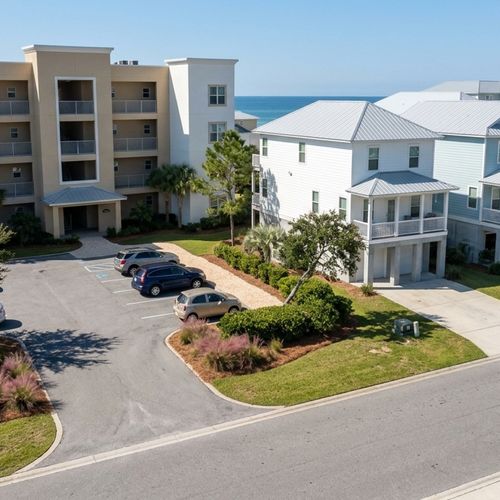

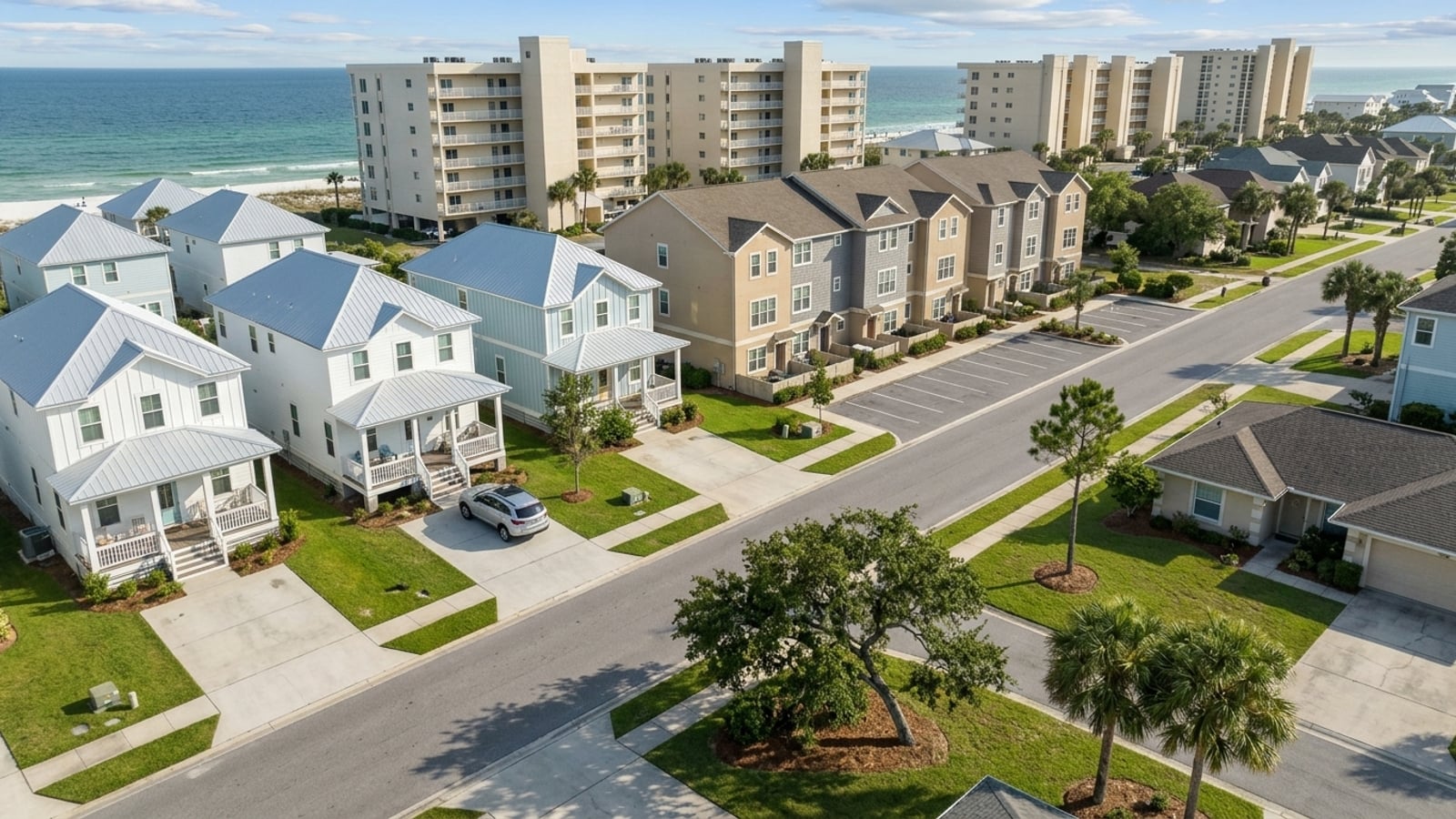
The right property management company in Panama City Beach, FL, comes down to what you own and how you plan to use it. The local market runs toward condominiums, but single-family homes and townhouses open up different rental possibilities entirely.
A manager built to turn over beachfront vacation rentals twice a week runs a completely different business than a long-term leasing brokerage. That match determines your net income and how cleanly you can exit the investment when the time comes.
Key Takeaway
For most Panama City Beach owners, the right property management company is a licensed vacation rental manager that already works within your condo building's rental rules, because condos made up 183 of the 290 sales in the 90 days ending September 30, 2026. If you own a single-family home, or your association bars stays under 30 days, a long-term manager experienced with Florida landlord-tenant law is a better fit. Either way, you should compare quotes based on what you net after every fee, not on the headline percentage.
Who This Guide Is For
You own, or are about to close on, a rental property in Panama City Beach and are deciding which management company, and which rental model, to hand it to.
Which Property Management Company Is Right for Your Panama City Beach Property?
The right property management company is the one built for what you own. Condos currently make up 646 of the 913 homes for sale, and their median price fell 4.7% over the past year while single-family homes rose 4.6%. Most owners are holding a condo through a slow resale market, which means the smart way to judge a manager is on net rental income after every fee and on its track record inside your building's rental rules. Single-family owners have a firmer exit strategy and can weigh long-term leasing or selling on more equal footing. Owners considering an annual lease can review specifics on long-term rental property management in Panama City Beach.
Start by checking whether your condo or HOA documents allow rentals shorter than 30 days. If not, skip vacation rental managers and focus on long-term leasing. If you want to use the property yourself for part of the year, ask each short-term manager how owner stays are blocked and what, if anything, you're charged for them. Owners likely to sell within two years should read contract cancellation terms carefully. And if you can't reach the property within a few hours during a storm warning, rule out self-managing and put hurricane response at the top of your interview agenda.
If you want nightly or weekly rental income from a condo whose documents allow stays under 30 days, start with a vacation rental manager that already manages units in your building and can show its state license. Condos are most of the market and resale is slow, so in-building experience protects your bookings while you hold. If you want steady income from a single-family home without constant turnover cleaning, start with a long-term manager holding a Florida broker license and written tenant-screening criteria. Single-family houses offer more space per dollar, and rising values mean an annual lease keeps upkeep predictable. Owners who want summer use of their condo plus some winter income should look for a manager that books monthly stays and blocks owner dates without penalty, since monthly arrangements can fit buildings with 30-day minimums and avoid transient-rental tax obligations. If you want out of landlord duties altogether, compare a sale against hiring a manager, because sale-to-list ratios show a market where buyers negotiate.
Gulf-Front and Resort Condos
Condominiums dominate the local rental market, but they're facing a slow resale environment right now. In the 90 days ending September 30, 2026, condos sat on the market for a median of 126 days, and the area holds 10.8 months of supply. If a manager underperforms, selling isn't a quick escape, so vetting companies hard up front is worth the effort.
Most condo towers along Front Beach Road run a front desk or an on-site rental program. An outside manager may be permitted but has to work around the association's check-in, parking-pass, and amenity-wristband rules. Ask the association whether outside managers are allowed and what they're required to register. Your association dues come out before any rental income reaches your bank account, so check your property's specific HOA fees to calculate your true net. With 10.8 months of supply, a condo that rents poorly is also hard to sell quickly, and locking into a long management contract makes that problem worse.
Single-Family Homes
A Panama City Beach house sells for about $110 less per square foot than a condo, based on median price per square foot in the 90 days ending September 30, 2026: single-family homes sold at a median $252 per square foot against $362 for condos. That extra space per dollar suits a long-term tenant and gives the owner more flexibility in choosing a rental model.
Rising values give single-family owners a firmer exit, meaning long-term leasing, vacation rentals, and selling are all real choices. Many local vacation rental firms are built to service condo towers, so ask each one how many detached homes it manages. What you give up is maintenance ease: yard, pool, roof, and exterior upkeep that a condo association would handle fall entirely on you, and maintenance markups add up faster on a detached house.
Townhouses
Townhouses present an unusual picture. Their median price dropped 7.8% year over year, yet they sold the fastest of any property type, and 1 in 10 still sold above asking. Those figures are based on just 31 sales in the 90 days ending September 30, 2026, so treat management here as a hold-and-review decision rather than a permanent path.
Rental rules for townhouses sit in each community's HOA documents and vary widely across Panama City Beach. With so few sales, market numbers can swing sharply from one quarter to the next, and each townhouse HOA sets its own minimum rental period, meaning a vacation-rental plan may be completely off the table depending on where you are.
Vacation Rental vs. Long-Term Property Management
Nightly vacation rentals and annual leases are different businesses that require different firms, different fee structures, and different legal obligations. A company managing a beachfront condo for tourists is focused on marketing, dynamic pricing, and rapid turnover cleaning. A long-term leasing brokerage is focused on tenant screening, lease enforcement, and property preservation. The rental model your property is legally allowed to use, and the one that fits your own plans for the home, tells you which type of company to hire.
Vacation Rental Management
Vacation rental management covers nightly and weekly stays, handling everything from booking platforms and dynamic pricing to guest messaging and turnover cleaning. Florida treats a unit rented more than three times a year for stays shorter than 30 days or one calendar month as a transient public lodging establishment, which triggers specific licensing requirements from the state.
When interviewing a short-term manager, ask for 12 months of actual occupancy and the average nightly rate on comparable units the firm already manages. Don't accept a projection. Income is seasonal, the commission is the highest of the three rental models, and any owner stays you book during peak weeks will directly cost you rental income.
Long-Term Rental Management
Long-term management handles annual leases and fits single-family homes or condos whose documents bar short stays. These managers handle tenant screening using written, standard criteria applied consistently to every applicant under fair housing law: income, credit, rental history. They also manage rent collection, routine inspections, and any evictions under Florida Statute 83.
You can review average rent figures for the area to get a sense of what an annual lease might yield. What you give up is any personal use of the property for the entire lease term, and one bad tenant can mean months of lost rent plus legal costs.
Winter Monthly Rentals
Winter monthly rentals cover stays of a month or longer during the off-season. These arrangements can work for buildings whose rules enforce 30-day minimums and for owners who want the property back during summer. Stays of a month or more generally fall outside the state's transient lodging definition, though you should confirm the exact tax treatment with a professional.
Ask whether the manager books monthly stays directly or only as part of its nightly program, and how its fee changes for a longer placement. Demand is concentrated in a few winter months, so expect the property to sit empty or need a nightly program to fill the rest of the year.
Property Management Fees in Panama City Beach
There's no official rate-setting body for management fees in Florida. Every contract is privately negotiated, and the headline percentage a company advertises is only one piece of what it costs to run your rental. A breakdown of a quote into its individual parts lets you line up two competing offers accurately. A lower management percentage applied to a larger base of fees can easily cost you more by year's end.
Management Fee Percentages
Ask exactly how the management percentage is calculated: whether it applies to gross bookings or net of platform fees, and whether it's based on collected rent or scheduled rent. Among firms that publish fees, full-service vacation rental management in the Panama City Beach market is commonly quoted around 10 to 15 percent of gross revenue for tech-enabled managers, with traditional full-service local managers often ranging up to 20 or 25 percent. For long-term rentals, published rates from local firms typically sit at 10 percent of the monthly rent.
The headline percentage is the least comparable number in the quote unless you know exactly what income it's applied to.
Leasing, Setup and Renewal Fees
One-time charges often include onboarding fees, professional photography, initial property inspections, and lease renewal fees. While no surveyed Panama City Beach long-term firm publishes a separate leasing or tenant-placement fee online, ask whether one applies and get the answer in writing.
Setup costs come out of your first few months of income. If you switch managers later, you pay these expenses all over again.
Cleaning, Linen and Booking Platform Fees
For vacation rentals, find out who keeps the guest-paid cleaning fee and whether linen service is billed to you as a separate owner charge. Find out whether booking-platform commissions and credit card processing fees come off the top before the manager calculates their cut. These are line items to verify directly with the company. When the manager keeps the cleaning fee and also bills you for linens, one turnover can effectively be paid for twice.
Maintenance Markups and Other Hidden Costs
Property managers often add vendor markups on repairs, charge for after-hours call-outs, or bill for storm preparation. Ask for the markup percentage and the specific dollar limit a manager can spend on repairs without coming to you first.
Holding costs like insurance and property taxes hit your statement but aren't manager fees. Rentals don't get Florida's homestead exemption, so reviewing your property tax bill is a necessary step in budgeting. Maintenance markups rarely appear on the first page of a proposal and usually surface only in the monthly statement.
Comparing Two Fee Quotes
Consider a hypothetical condo generating $40,000 in gross annual bookings. Quote A offers a 15 percent commission but passes cleaning, linen, and credit card processing fees to the owner, and adds a 10 percent markup on all repairs. Quote B charges a 22 percent all-inclusive commission with no extra owner fees for turnovers or repair markups.
When you subtract the additional charges from Quote A, Quote B can often net the owner more money despite the higher headline percentage. Ask both firms to fill in the same line items for your specific unit. A firm that won't disclose every line item is answering the question for you.
Florida Licenses and Rules a Property Manager Must Follow
Florida requires licensed real estate brokers to hold other people's money, including rents and deposits, in a separate escrow account. Under state law, a broker must place these funds in a trust account within three business days and reconcile the account monthly. Managing a rental property involves strict adherence to state statutes, local ordinances, and community rules, and a clear grasp of what a competent manager must handle lets you check their work.
How to Verify a Manager's License
You can look up a management firm and its broker on the Florida Department of Business and Professional Regulation (DBPR) license search to confirm they're legally permitted to operate. Rent and security deposits held for owners belong in a broker escrow account, not an operating account.
Ask which bank holds the firm's escrow account and request a redacted owner statement that shows trust balances. A clean license record is the floor, not the bar: it proves the firm can legally manage property, not that it manages yours well.
Vacation Rental Licenses and Tourist Tax Registration
A short-term rental needs a DBPR vacation rental license, registration with the state and county for transient rental taxes, and any required city-level certificates. Clarify in the contract whether the manager or the owner is responsible for filing these applications and remitting the taxes, and ask the manager for the unit's license number and proof of their tax filings.
If the manager fails to file or remit taxes, the obligation still traces back to the property and its owner. That's not a technicality worth finding out the hard way.
HOA and Condo Association Rental Rules
Condo and homeowner associations enforce minimum rental periods, guest limits, parking rules, and outside-manager restrictions. Under Florida condo law, a rental restriction added after you bought generally applies only to owners who voted for it or who buy after it passes, effectively grandfathering existing non-consenting owners until they sell.
Get the current declaration, rules, and any pending amendments from your association before choosing a rental model. This legal protection has limits and exceptions, and associations can still enforce rules that were already in the documents when you bought.
Florida Landlord-Tenant Law for Annual Leases
A long-term manager must correctly handle required notices, timelines for nonpayment, and lawful entry. Florida's notice for unpaid rent gives the tenant three days, not counting weekends or legal holidays, to pay or face eviction proceedings.
Ask how many evictions the firm filed last year and who pays the court and attorney costs if a tenancy goes wrong. One missed notice step can restart the eviction clock, and that cost lands squarely on the owner.
How to Interview a Property Management Company
An interview with a property manager is about verifying past performance, not evaluating future projections. The companies that show up in local search results handle hundreds of properties, but their processes may not align with your specific goals. A professional firm will have written policies and sample documents ready to share; if they don't, that's useful information too.
Questions to Ask Before You Sign
Start by asking how many units the firm manages in your specific building or community type. Find out its actual occupancy rate or average days-to-lease on comparable units, what exactly the management fee is based on, and what the company can spend on repairs without asking you first. Ask who your single point of contact will be and when statements and payouts arrive each month.
Request a redacted owner statement from a comparable unit to see how fees are reported. Numbers from a sales pitch are projections. Past statements on similar units are what you're likely to earn.
Hurricane and Storm Response
Hurricane Michael made landfall near Mexico Beach in adjacent Bay County as a Category 5 storm in October 2018. Severe weather is a real operational factor here, not a hypothetical. You should know who secures the unit, the order in which units are checked after a storm, how photo documentation is handled for insurance claims, and how guest cancellations and refunds are processed.
Ask to see the firm's storm plan in writing, and review local storm and safety data to understand your property's exposure. After a major storm, every manager is stretched at once, and your place in the queue depends entirely on the contract, not goodwill.
Reviews, References and Complaint Records
Owner reviews matter more than guest reviews when you're hiring a manager. Ask the company for two current owner references who hold properties similar to yours, check the DBPR license record for disciplinary actions, and read local forum threads with appropriate skepticism.
Ask the firm directly whether any owner left in the past year and why. Guest-facing star ratings measure how happy renters were. They say very little about how well a firm accounts for an owner's money.
Contract Length and Cancellation Terms
Review the agreement for its initial term, auto-renewal clauses, notice periods, and termination fees. Find out exactly who keeps future bookings and how deposits and trust balances are handed over if you leave. This matters for every owner, but it's especially worth scrutinizing for condo owners given the 126-day median time on market.
Seltzer Real Estate can talk through how a management contract may affect a future sale if you decide to list the property. Future bookings the manager already holds can tie up a sale or a switch for months, unless the contract specifically addresses how they transfer.
When to Self-Manage or Sell Instead
Not every property needs a third-party management company. Florida generally exempts owners who manage their own real property from needing a real estate license, so running the rental yourself is a legitimate option. Owners who don't want the daily work of a rental business can also look at the current sales market. A comparison of both against a management contract helps clarify what you want from this investment.
Self-Managing a Rental From a Distance
Self-managing means securing the same city and state licenses, filing the same tourist taxes, and building a reliable roster of local cleaners and handymen. You need someone on call for emergencies and a concrete plan for storm preparation.
Managing from afar is a logistics business. Saving the commission only works if you can reliably get someone to the unit fast: a missed turnover or a storm-damaged unit sitting unattended easily costs more than the fee you would have paid.
Selling Instead of Hiring a Manager
Owners who don't want to self-manage or pay a third party can compare a sale. In the 90 days ending September 30, 2026, all homes in the market sold at 95.4% of list price, so expect to negotiate with buyers, particularly on a condo.
Your expected selling timeline and seller closing costs will show you what you might walk away with. Seltzer Real Estate can run a precise price check if you're weighing a sale against renting. In a buyer-leaning market, selling now may lock in a lower price than holding and renting for a few more years would.
At a Glance
- All homes, 90 days ending 2026-09-30: median sale price $364,526, up 2.7% year over year; 290 homes sold.
- All homes, 90 days ending 2026-09-30: median 100 days on market, 95.4% sale-to-list, 2.8% sold above list, 9.6 months of supply, 913 homes for sale, $313 median price per sq ft.
- Condos, 90 days ending 2026-09-30: median sale price $328,966, down 4.7% year over year; 183 sold; median 126 days on market; 95% sale-to-list; 10.8 months of supply; 646 for sale; $362 median price per sq ft.
- Single-family homes, 90 days ending 2026-09-30: median sale price $449,821, up 4.6% year over year; 78 sold; median 76 days on market; 96% sale-to-list; 6.9 months of supply; 175 for sale; $252 median price per sq ft.
- Townhouses, 90 days ending 2026-09-30 (based on only 31 sales, so treat with caution): median sale price $295,004, down 7.8% year over year; median 54 days on market; 96.4% sale-to-list; 10% sold above list; 7.4 months of supply; 74 for sale; $248 median price per sq ft.
Panama City Beach Property Management FAQs
Do Property Managers Need a Real Estate License in Florida?
Yes, managing rentals for others for compensation generally requires a Florida real estate broker's license. Florida Statute 475.011(2) exempts owners managing their own property, provided they do not pay a commission on a transactional basis to an unlicensed agent or employee to make leases. This is general information, not legal advice, so check with the state or an attorney regarding specific exemptions.
What Is the Difference Between a Property Manager and a Community Association Manager?
A rental property manager works for the individual unit owner, while a community association manager (CAM) runs the HOA or condo association itself. Florida licenses CAMs separately under Chapter 468 for associations with more than 10 units or budgets over $100,000. This matters because your building's management company is usually not your personal rental manager.
What Taxes Do Vacation Rentals Pay in Panama City Beach?
Vacation rentals in Panama City Beach are subject to Florida state sales tax on transient rentals and the Bay County tourist development tax. The city also requires a Vacation Rental Certificate, which involves a life-safety inspection setting maximum occupancy at one person per 150 square feet of habitable space. Tax treatment for a specific property is a question for a tax professional.
What Are Florida's Rules for Rental Security Deposits?
Under Florida Statutes §83.49, a landlord has 15 days to return a security deposit if they do not intend to make a claim on it. If they do impose a claim, they have 30 days to give the tenant written notice by certified mail or email, after which the tenant has 15 days to object. You should ask the manager whose account holds the deposit to ensure compliance.
How Long Does It Take to Find a Long-Term Tenant in Panama City Beach?
It depends entirely on the property type, condition, and price. Ask each prospective manager for its average days-to-lease on comparable units over the past year. Don't rely on estimates or projections that aren't backed by a firm's actual leasing history.
Do I Need Flood Insurance on a Rental Property in Panama City Beach?
Yes, if you have a federally backed mortgage and the property sits in a Special Flood Hazard Area (SFHA). Congress mandates that lenders require flood insurance for these buildings, and failure to enforce this can result in fines. Look up your parcel on FEMA's flood map, check your flood insurance options, and ask your insurer about specific rental-use coverage.
Sources
- Redfin: Data Center
- The PM Cost Guide: Best of Key West Rentals Truman and Co
- Florida Legislature: Statute 475.011
- Florida Legislature: Statute 475.25
- Florida DBPR: VRTSP Guide
- STR Law Map: Panama City Beach Short-Term Rental Rules
- Outfast Property Management: HOA Rental Restrictions Florida
- Florida Senate: Statute 83.49
- Florida Realtors: Florida Landlord Tenant Laws Residential
- Florida House: Chapter 468 Part VIII
- National Hurricane Center: AL142018 Michael
- FEMA: Realtor Lending Insurance
Check out this article next